One of summer’s most treasured family traditions is sitting around a campfire, enjoying the company of the ones we love. Whether we’re roasting marshmallows or telling scary stories, it’s important that we respect the nature around us and enjoy this tradition safely. TCHD wants to spread the word about campfire safety so we can savor our s’mores without worry.
 This is Public Health is brought to you in partnership with the Tuscarawas County Health Department.
Smokey the Bear has been helping campers use fire safely for almost 80 years. According to smokeybear.com, we can follow just a few simple steps to keep everyone safe!
How to Pick Your Campfire Spot
- DO NOT build a campfire if the campground, area or event rules prohibit them. Sometimes digging of pits may be prohibited due to archaeological or other concerns.
- DO NOT build a campfire in hazardous, dry conditions.
- FIND OUT if the campground has an existing fire ring or fire pit.
- If there is not an existing fire pit, and pits are allowed, choose a site at least 15 feet from tent walls, shrubs, trees or other flammable objects. Beware of low-hanging branches.
- Choose an open, level location away from heavy fuels such as logs, brush or decaying leaves.
- Take wind, and its direction, into account when choosing the site. Choose a spot that’s protected from gusts.
How to Prepare Your Campfire Pit
- Clear a 10-foot-diameter area around the site. Remove any grass, twigs, leaves and firewood.
- Dig a pit in the dirt, about a foot deep.
- Circle the pit with rocks.
- Your campfire pit is built and ready for building a campfire!
How to Build Your Campfire
- First, make sure you have a source of water, a bucket and shovel nearby at all times.
- Gather three types of wood from the ground-NEVER cut whole trees or branches, dead or alive.
- Tinder: Small twigs and dry leaves, grass and needles.
- Kindling: Sticks smaller than 1″ around.
- Fuel: Larger pieces of wood. Keep these stacked upwind, away from the fire.
- Loosely pile a few handfuls of tinder in the center of the fire pit.
- Add kindling in one of these methods:
Best for cooking
- Teepee: Lay the kindling over the tinder like you’re building a tent.
- Lean-to: Drive a long piece of kindling into the ground at an angle over the tinder. Lean smaller pieces of kindling against the longer piece.
Best for long-lasting campfires
- Cross: Crisscross the kindling over the tinder.
- Log Cabin: Surround your pile of tinder with kindling, stacking pieces at right angles. Top the “cabin” with the smallest kindling.
- Ignite the tinder with a match or lighter.
6. Wait until the match is cold, and discard it into the fire.
7. Add more tinder as the fire grows.
8. Blow lightly at the base of the fire.
9. Add kindling and fuel, the larger firewood, to keep the fire going.
How to Safely Maintain Your Campfire
- Once you have a strong fire going, add larger pieces of dry wood to keep it burning steadily.
- Don’t burn dangerous things like aerosol cans, pressurized containers, glass or aluminum cans. They could explode, shatter and/or create harmful fumes or dust.
- Keep your fire to a manageable size.
- Make sure children and pets are supervised near the fire. Never leave your campfire unattended.
How to Extinguish Your Campfire
- Allow the wood to burn completely to ash, if possible.
- Pour lots of water on the fire. Drown ALL embers, not just the red ones. Pour until hissing sound stops.
- If you do not have water, stir dirt or sand into the embers with a shovel to bury the fire.
- With your shovel, scrape any remaining sticks and logs to remove any embers. Make sure that no embers are exposed and still smoldering.
- Continue adding water, dirt or sand and stirring with a shovel until all material is cool.
Remember:
If it’s too hot to touch, it’s too hot to leave
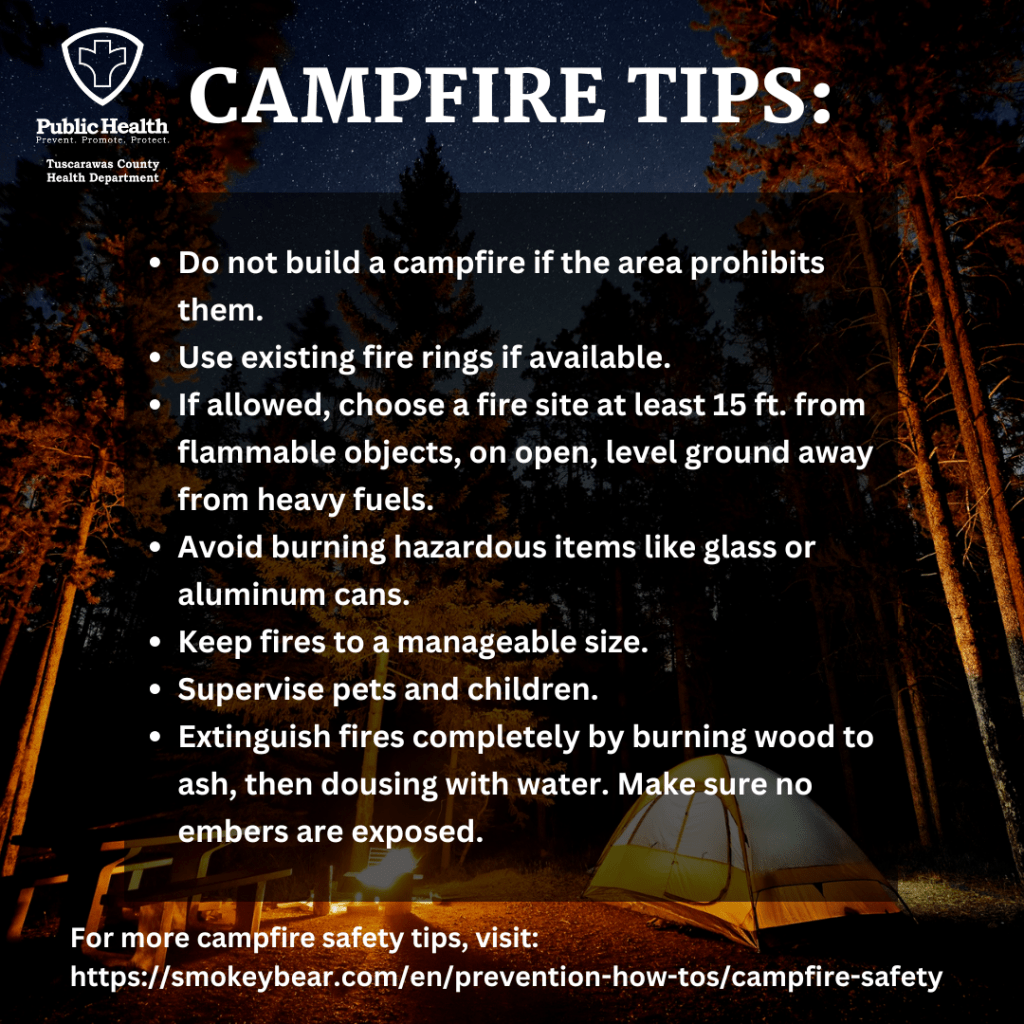
Use this easy infographic from the Tuscarawas County Health Department to help you remember all of these important fire safety tips!