So you rinse your recyclables and place them in your bin for collection every week.. But have you ever wondered what happens once it’s all hauled away? How can recycling facilities possibly manage to separate all of those materials??
This informational article about the process of sorting recyclables is brought to you in partnership with the Stark- Tuscarawas- Wayne Joint Solid Waste District.
Through an impressive and complicated series of sorting methods, recycling facilities are able to effectively separate tons and tons of collected recycling. The sorting of glass, aluminum, cardboard and plastic keeps these materials out of the landfill and gives them a chance to be reused. Let’s take a look at just how they do it..
The Tip Floor
All recyclables collected throughout the community makes its way the the recycling facility where it is dumped in one big room they call the “tip floor”
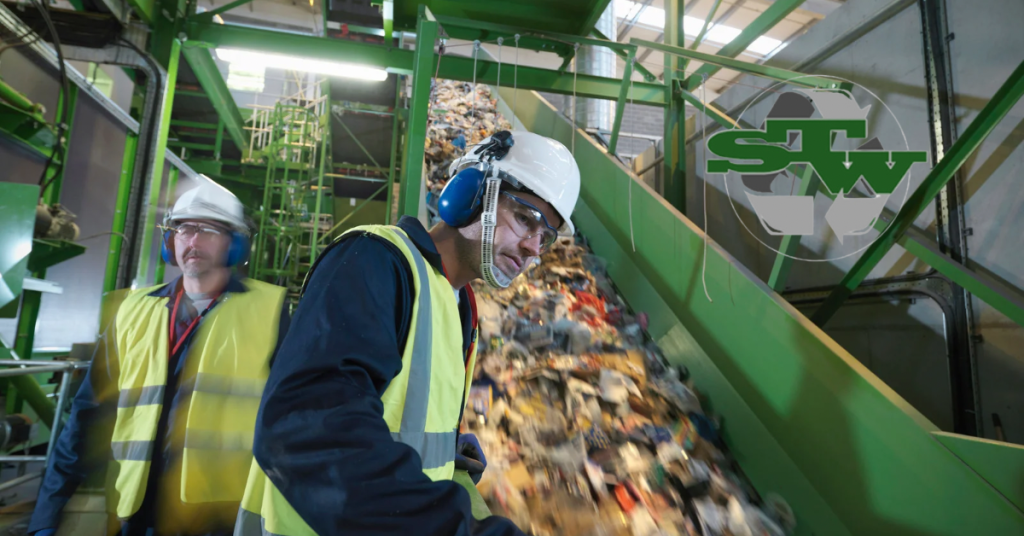
From here, a loader pushes the materials onto a conveyor belt. Materials are carried through the facility and several sorting machines on a series of conveyor belts.
Pre-Sorting
The conveyor belt first brings all materials past a line of workers who begin to separate out contaminants.
Contaminants are things that end up in the recycling, but aren’t recyclable. Things like plastic bags, styrofoam, hazardous materials and other garbage has to be removed. Sorting out contaminants is one of the biggest challenges recycling plants face. That’s why it’s so important for us to prepare and sort our recycling properly.
Cardboard Screening
Next the recyclables come to a screening machine that pulls out all of the cardboard. The machine is designed to catch the cardboard while other materials fall onto a conveyor belt below.
Bottle Breaker
Glass is next up. A machine called the bottle breaker catches the glass and breaks it into a bunch of small pieces. Those pieces fall onto their own conveyor. They’ll go on to be crushed even further and then used in construction.
More and more screening..
From here, the materials move along a conveyor belt specifically designed to separate the paper from plastic. The lighter paper items float right along on top of the screen while plastic bottles and aluminum cans bounce down.
Those paper items continue on to their second sets of human hands. On another sorting floor, workers pull out any cardboard or contaminants that made it through. Leaving only the light, paper material from newspaper and office papers.
The plastic and metal materials are sent through one more screen known as the “ballistic screen” to pull out any remaining paper or cardboard. Then it gets to meet its second floor of human sorters.
Plastics, plastics, plastics.
At this point the conveyor belt full of plastics and metals passes by a group of workers. These people quickly go through the materials, pulling out the plastic that is eligible for recycling.
We can help this process by doing our best to only recycle the plastics that can be recycled. Here’s a helpful article that lays out the current recommendations for plastic recycling in our district: The Plastic Puzzle- Newsymom.
Electromagnets
Now it’s the metals’ turn. The conveyor belt passes under a strong electromagnet that pulls ferrous metals up. Ferrous metals are all the metals that contain iron, one example is soup cans.
Last sorter
Finally, the last line of workers jon is to pull out all of the aluminum. Aluminum cans, pie pans and foil are all fully recyclable and will be morphed into a brand new aluminum product in no time.
Now What?
Once the recyclables have made it through the intense sorting process, the different materials are compacted into giant cubes.
These cubes are then sold to companies who are able to recycle them into new products!
For a visual on this crazy process, check out this youtube video: https://www.youtube.com/watch?v=NYux4-KIY1o
As you can see, the sorting process is a tedious one. A process that includes not only mechanical sorters but multiple floors of human hands as well. Breaking down how these processes work highlights the importance of proper recycling practices. By separating our waste and ensuring our recyclables are free of contaminants, we can contribute to enhanced efficiency in our local recycling programs.
Good recycling habits help conserve natural resources and reduce the amount of waste in the landfill. Recycling also supports the economy by creating jobs and fostering sustainable industries. By making conscious efforts in recycling, we can all contribute to a healthier planet and a greener future.
For more recycling information and recommendations, check out the various educational blog posts provided by the Stark-Tuscarawas-Wayne Recycling District.

The Recycling District assures safe and sanitary disposal of solid waste for the residents of Stark, Tuscarawas, and Wayne Counties. Their goal is to reduce reusable or renewable wastes from entering landfills within the district. The Solid Waste District accomplish this through the development of residential and industrial programs that educate, promote, provide, implement, and improve recycling opportunities that will preserve landfill space now and into the future. Visit www.timetorecycle.org for more information.