There are a lot of assumptions about childcare, what it is, what it isn’t, and what actually happens throughout the day.
If I’m being honest, I never imagined I would one day own an early learning center. My career began with a passion for journalism, I thought I’d be on TV, traveling the world, covering important stories and bringing transparency directly to people. That path led me into the public safety sector, where I spent nearly a decade believing that’s where I would stay.
But that experience did something deeper, it sharpened something that had always been there: a desire to help, to serve, and to make a meaningful difference in people’s lives, and a growing trust in God’s plan, even when I didn’t fully understand where it was leading.
Today, I still carry my public safety work forward in my role supporting agencies across the country, helping them better connect with and build trust within the communities they serve. It’s a privilege to continue this work long-term, while also having the opportunity to build something of my own that reflects that same passion for serving others, something I never expected: owning an early learning center.
At first glance, those two paths may not seem connected. But at their core, they are rooted in the same purpose, to serve, to connect, to build relationships, and to communicate in ways that truly make a difference. One focuses on strengthening communities, while the other focuses on strengthening families. And when you look at it through that lens, it makes perfect sense. How blessed am I to be given the opportunity to be in both spaces.
Flourish is brought to life each day by a strong, dedicated team who lead the day-to-day experience for our children and families. Their work is what makes this environment so meaningful, while I remain focused on the vision, the standards we uphold, and the resources needed to ensure the center continues to grow and succeed in the way it was intended. Because of that structure, I’m able to stay focused on both my roles in a way that ensures neither is compromised.
In that role, I’ve had conversations with families, community members, and even executive-level leaders who are often surprised to learn what early childhood education truly involves.
So instead of a traditional article, I wanted to share this in a conversational way, answering some of the most common questions and misconceptions I hear, and offering a clearer picture of what really happens inside an early learning center.
 Question: There’s still a common perception that childcare is simply “daycare.” What would you say to that?
Answer: I understand where that perception comes from, but honestly, it’s outdated.
Today’s early learning centers are designed with intention, structure, and developmental purpose. Yes, we provide care so families can work and function, but what happens within that care is meaningful, research-informed early education for children from birth through age five.
Providers are not just supervising children, they are shaping the earliest stages of how they think, communicate, regulate emotions, and build relationships. That’s foundational learning.
 Question: Some people assume that if teachers don’t all have college degrees, the environment isn’t educational. How do you respond?
Answer: That’s another misconception we’re working to shift. Early childhood educators, both in preschool-only settings and childcare settings, are teachers.
While some of our team members absolutely have college-level education and degrees, not every staff member does. But, every person working in a licensed center completes ongoing, state-approved professional development and training. That includes training in child development, health and safety, behavior guidance, and more. Many pursue additional credentials and certifications through organizations like the Ohio Department of Children and Youth and the Ohio Child Care Resource and Referral Association.
This field requires constant learning because children are constantly growing, and we have to grow with them.
 Question: What kind of training are early childhood educators actually required to complete?
Answer: There’s quite a bit. Staff are trained in safe sleep practices, first aid and CPR, communicable disease prevention, child abuse recognition and reporting, and emergency preparedness, just to name a few.
Beyond safety, they’re also trained in developmental milestones, behavior and social-emotional support, family engagement, and inclusive practices. Many stay closely connected to community resources, so when a family needs support, whether it’s food assistance, developmental screenings, or mental health services, they can help guide them in the right direction.
And just as importantly, at Flourish, we recognize that not every center is the right fit for every child or every family, and that’s okay. If a child’s needs extend beyond what can effectively be provided, my team is trained to help connect families with specialists and services who can help. Our role is to do our part in ensuring each child has the opportunity to truly thrive, even if that means helping a family find support beyond our walls.
Early learning centers often become a trusted starting point for families, helping connect them to the right resources at the right time.
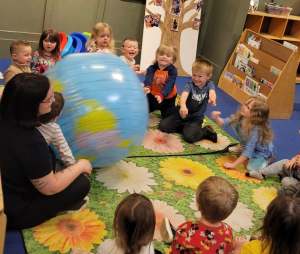 Question: What are children actually learning throughout the day?
Answer: This is one of the most important things for families to understand: learning in early childhood isn’t just academic, it’s developmental.
From birth to age five, children are building the foundation for everything that comes later. That includes:
- Social-emotional skills: understanding feelings, self-regulation, empathy
- Communication and language development: expressing needs, expanding vocabulary, early literacy exposure
- Cognitive development: problem-solving, curiosity, cause and effect
- Fine motor skills: grasping, drawing, manipulating small objects
- Gross motor skills: balance, coordination, movement
- Executive functioning: attention, memory, following directions
Research from the Harvard University Center on the Developing Child shows that these early experiences shape the architecture of the brain and are directly linked to long-term success in school, career, and overall well-being.
And here’s the key: this learning doesn’t just happen during a “lesson.” In an environment like Flourish, it happens all day long.
 Question: What does “learning all day long” actually look like?
Answer: It looks like intentionality in everything we do.
When a toddler is stacking blocks, they’re learning spatial awareness and problem-solving. When children navigate a disagreement over a toy, they’re developing conflict resolution and emotional regulation.
Meal times become opportunities for independence, social interaction, and even early math and science concepts. Outdoor play builds coordination, confidence, and risk assessment.
Even transitions like cleaning up or moving between activities, help children practice listening, routines, and cooperation.
Pretend play builds language, creativity, and real-world understanding. Using crayons, scissors, and small tools strengthens the hand muscles needed for writing and independence. Circle time builds attention and comprehension. Waiting in line builds patience and impulse control.
And even rest time, something many people don’t think of as learning, is deeply developmental. Learning to rest, regulate the body, and recharge is a skill. Children rely on these moments to process everything they’ve experienced throughout the day.
There is purpose behind every part of the day.
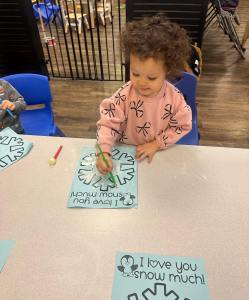 Question: “I just need a safe place for my child while I work.” How does that fit into this?
Answer: Safety is the baseline, it’s non-negotiable. Families should absolutely expect a safe, nurturing environment.
But quality early learning centers go beyond that baseline. Licensing standards set by the Ohio Department of Children and Youth ensure that programs are not just providing supervision, but supporting development in meaningful ways. At Flourish, we take that responsibility seriously and look for every opportunity to elevate it, through intentional activities, purposeful interactions, and thoughtful learning moments woven throughout the day.
So yes, my team is caring for your child throughout the day, but they are also intentionally supporting their growth every step of the way.
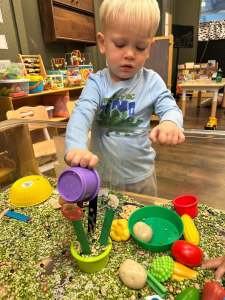 Question: Is this just babysitting?
Answer: No! And I say that with respect for how much trust families place in us.
We are caring for children during the most critical years of brain development. We’re supporting first friendships, first words, first independence. We’re helping children learn how to trust, express themselves, and navigate the world.
That’s not babysitting, that’s early education, relationship-building, and developmental guidance all working together.
 Question: What should families look for when choosing a center?
Answer: Look beyond labels, and beyond any single snapshot of someone else’s experience.
Ask about the environment, the interactions, and the intention behind the day. Watch how teachers engage with children, do they get down on their level? Do they encourage exploration? Do they support emotions?
A quality program is best understood when you see it, feel it, and experience it for yourself. It should feel like a partnership, one where your child is not only cared for, but truly known, supported, and growing.
 Question: What should families understand about how care works in a center setting?
Answer: It’s a shared, community environment, much like a traditional classroom you picture when your child goes off to school.
While we take time to know each individual child, we are also guiding a group of children learning and growing together. That means there are moments of individualized attention, and also moments where children are learning essential life skills within a group like patience, flexibility, cooperation, and independence.
That balance is intentional, and those group experiences are one of the greatest strengths of early learning environments.
 Question: What should families understand about policies in an early learning center?
Answer: Policies are an important part of how a center functions, and they exist for a reason.
In a licensed program, guidelines are not just preferences; many are rooted in requirements set by the Ohio Department of Children and Youth to ensure the safety, health, and well-being of all children in care.
But beyond licensing, policies also help create consistency. In a setting where multiple children are being cared for and supported throughout the day, clear expectations allow us to provide a stable, predictable environment, one where children can feel secure and thrive.
We also view policies as part of our partnership with families. They help ensure that everyone is working from the same understanding, which ultimately supports each child more effectively. When families and centers are aligned, it creates a stronger, more consistent experience for the child both at home and in the classroom.
At Flourish, we approach policies with intention and transparency. They are not meant to create barriers, they are in place to protect, to guide, and to support the kind of environment every child deserves.
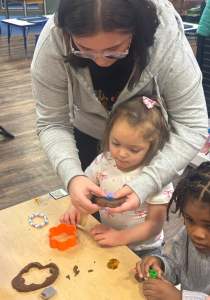 Question: What sets Flourish apart?
Answer: At Flourish, our focus has always been on meeting families where they are because the reality is, not every family fits into a traditional mold, and childcare and early learning experiences shouldn’t expect them to.
We offer flexible options, including hybrid, part-time, and full-time care, along with drop-off availability throughout much of the day to better support real-life schedules. Not everyone works a traditional 8–5, and we’ve built our model with that understanding in mind.
Beyond scheduling, we also see ourselves as part of something bigger than our walls. We actively engage in our community hosting events, sponsoring Newsymom’s free monthly playdates at the YMCA, and supporting local organizations that are making a meaningful difference for families.
We believe strongly in partnership, not just with the families we serve, but with other organizations and resources in the community. When we align and work together instead of operating in silos, we’re able to create something stronger and more supportive for everyone involved.
At its core, what sets Flourish apart is a commitment to flexibility, connection, and community, because supporting families well means understanding their realities and showing up in ways that truly make a difference.
 Question: What do you wish more people understood about this profession?
Answer: That this work matters, deeply.
Early childhood educators are helping shape the future, one interaction at a time. And while it may not always look like traditional “school,” the learning happening in these early years is some of the most important learning a child will ever do.
I also wish there was a broader understanding of the reality behind this work. Much like K–12 educators, people don’t enter this field for financial gain, they enter it because they care deeply about children and families and want to make a difference in the community.
Early learning centers operate within a challenging balance: maintaining high-quality care, meeting state standards, and keeping tuition accessible for families. In many communities, there’s a ceiling to what families can reasonably afford, and when costs rise too high, access to care becomes limited, which impacts not just families, but the entire community.
 Question: How does early learning and childcare impact a community as a whole?
Answer: Childcare is often viewed as a family need, but in reality, it’s a critical piece of a community’s infrastructure.
When families have access to reliable, high-quality early learning, it allows them to work, contribute to the workforce, and pursue opportunities that support their households and allow their families to thrive. That stability has a ripple effect as it supports local businesses, strengthens the economy, and helps communities function the way they’re meant to.
At the same time, children are building the foundational skills they need long before they ever enter a traditional school setting. They’re learning how to communicate, how to regulate emotions, how to build relationships, and how to engage with the world around them. Those early experiences shape not just individual outcomes, but the overall health and strength of a community over time. The children in our centers today become our leaders, decision makers, and workforce tomorrow.
So when we talk about childcare, we’re not just talking about care, we’re talking about workforce support, family stability, and long-term community impact. It may not always be visible in the moment, but this work plays a role in everything from school readiness to economic stability to the strength of our communities years down the road.
This work is driven by purpose, but it also requires an incredible amount of commitment, adaptability, and heart. And greater understanding of that balance helps strengthen the system families rely on every single day.
Just like in public safety, the strongest communities are built long before a crisis ever begins, through connection, trust, and the kind of transparency that turns information into understanding and support. The work I have been called to do, in both spaces, isn’t about filling a day, it’s about shaping a future and I feel honored to be here.
By Michaela Thomas, Owner of Flourish Early Learning Center